

A soundbar offers a simple audio upgrade with fewer speakers and less wiring. A surround sound system gives more precise sound from several points around the room. A subwoofer can improve either option by adding deep bass. The right home theater setup depends on your room, viewing habits, and budget.
Table of Contents
Soundbar vs Surround Sound: Key Differences
A soundbar places several small drivers inside one slim cabinet. Traditional speakers use separate left, center, right, and surround units.
| Feature | Soundbar | Surround Sound System |
| Setup | Fast and compact | More planning and wiring |
| Placement | Mainly below the TV | Around the room |
| Sound direction | Virtual or reflected effects | Sound comes from separate speakers |
| Upgrades | Often limited by the brand | Easier to expand or replace |
| Best fit | Living rooms and small spaces | Large rooms and theater rooms |
A custom home theater setup improves placement, hidden wiring, TV links, and room tuning. It does not turn a basic soundbar into separate speakers. Its main benefit is making the system fit the room and seating.
The best soundbar should support your TV, room size, and favorite content. Current models may include HDMI eARC, Dolby Atmos, and optional rear speakers. HDMI Licensing Administrator states that eARC sends TV audio to a soundbar or receiver through one HDMI cable.
Should You Get a Soundbar or Speakers?

Choose a soundbar when you want:
- Fewer visible parts
- Simple daily controls
- Clearer TV speech
- Less wiring in a finished room
Choose traditional speakers when you want:
- A wider front soundstage
- Clear effects beside and behind you
- More control over each channel
- Room to expand later
For a shared living room, a soundbar often provides the best balance. For a theater room, separate speakers give more exact placement and stronger surround effects.
Do You Need a Subwoofer?
You can hear speech without a subwoofer. However, a subwoofer adds low bass from films, games, sports, and music. Dolby defines the “.1” in 5.1 as the low-frequency effects channel.
Audio is received by a wireless subwoofer without the need for a long signal cable. It still requires a wall outlet and needs to be compatible with the transmitter or soundbar. A wired subwoofer avoids wireless pairing problems by using an audio cable.
When examining a subwoofer such as the vintage MartinLogan Dynamo 700W, go over:
- Size and location of the room
- System fit and inputs
- Driver size and power rating
- Crossover, phase, and level controls
The Dynamo 700W has a 10-inch driver, 300 watts RMS, and a peak power of 600 watts, according to MartinLogan. It is compatible with both wired and wireless transmitters. Examine the transmitter, cables, and operational controls of the used units.
Do You Need a Subwoofer?
A subwoofer is not required for clear speech, but it adds the deep bass and low-frequency effects heard in films, games, sports, and music.
Wired or Wireless?
Wireless: Sends audio without a long signal cable, but still requires power and compatible equipment.
Wired: Uses an audio cable and avoids wireless pairing issues.
What to Check
- Room size and placement
- System compatibility and inputs
- Driver size and power
- Crossover, phase, and level controls
Dynamo 700W Example
Supports wired and wireless transmitter connections. For used units, inspect the transmitter, cables, inputs, and controls.
Wired vs Wireless 5.1 Soundbars
A 5.1 system has five main audio channels and one bass channel. Some soundbar packages include two rear speakers. Others create rear effects through side-firing drivers or audio processing.
Wired rear speakers use signal cables and can avoid wireless signal drops. Wireless rears use a brand-based wireless link. Most wireless speakers still need power cables.
Choose wired speakers during a remodel or new build. Choose wireless rear speakers if running and concealing long cables would be difficult.
Are Forward-Facing TV Speakers Enough?
They could give clearer speeches and dialogues than speakers aimed down or behind the screen.
They still have small drivers and limited space for bass. They also cannot place real speakers behind the listener. They suit casual viewing, but movie fans often gain more from a soundbar or surround sound system.
Planning Your Home Cinema Installation
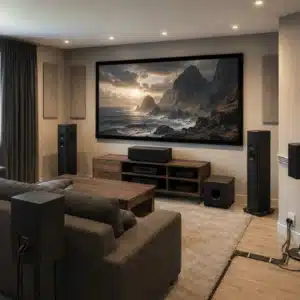
More is required for a robust home theater system than just high-quality speakers. Organize the system around:
- Size, shape, and ceiling height of the space
- Viewing distance and main seats
- Lighting in the room and daylight
- Location of a TV or projector
- Power outlets and cable routes
- Network access and intelligent controls
Start with viewing comfort and seating distance when determining screen size. Matching the display to the room, seats, and viewing angles is advised by CEDIA. A TV works well in bright rooms. The right screen and planned light control are essential for projectors.
During a home theater consultation, an installer should:
- Inspect the room and cable routes.
- Discuss your films, games, music, and budget.
- Recommend a display, speakers, controls, and room tuning.
How do I choose the best home cinema installation service?
Choose an installer who checks the room before recommending equipment. Ask about design, wiring, setup, room tuning, warranties, and support. Review past theater projects and confirm that trained staff complete the work.
What should I consider when choosing a home cinema display?
Check seating distance, room light, screen size, and viewing angles. TVs work well in bright and mixed-use rooms. Projectors need enough throw distance, light control, and a screen suited to the projector.
Can you recommend top audio specialists for a home theater setup?
Look for an AV firm with design and installation experience. Good specialists support several trusted brands instead of forcing one package. In Central Texas, Custom Integrators offers system design, installation, room tuning, and follow-up support.
How many speakers do I need for a home theater setup?
The number of speakers depends on the type of system you want. A basic soundbar may use one main unit, while a 5.1 surround sound system typically includes five main audio channels and a subwoofer. Larger systems can add more surround or overhead speakers for a more immersive experience.
Is a soundbar considered surround sound?
Some soundbars create virtual surround effects from one cabinet. Others add separate rear speakers for clearer sound behind the listener. Check the speaker layout instead of relying only on the channel label.
What happens during a home theater consultation?
The installer checks the room, seats, light, wiring, and network. You discuss your budget and how you use the space. The installer then plans the display, audio system, controls, and installation work.
A soundbar suits simple living-room upgrades. Separate speakers offer stronger placement and room for future changes. A matched subwoofer adds bass to either system. Custom Integrators has served Central Texas since 2009. Book a home theater consultation or request a free estimate today for a system built around your room.