
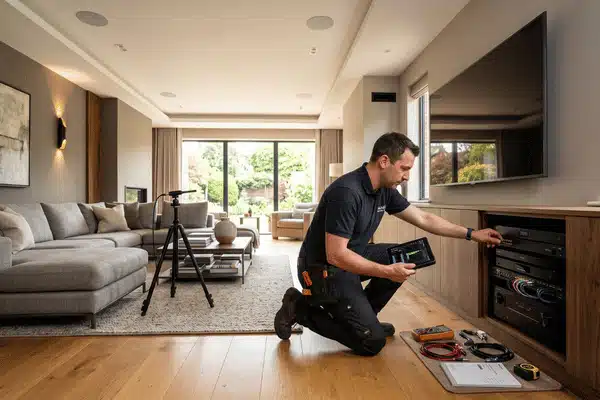
Installing speakers is only one aspect of installing a home audio system. Design, wiring, calibration, and control are all covered. When done correctly, it alters the sound and atmosphere of your house. This guide contains all the information you need to make informed decisions before you invest money, from 2026 costs to expert setup advice.
Table of Contents
What Type of System Are You Installing?
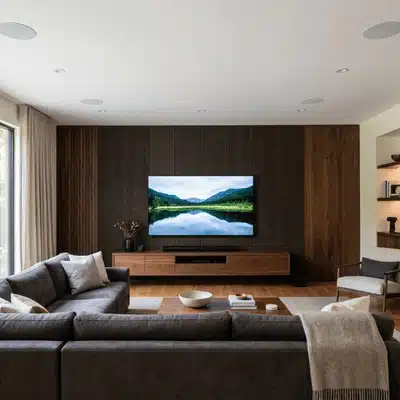
Not every home sound system installation looks the same. Your goal determines the scope, cost, and approach.
Single-Room TV and Music Upgrade
This is the most common starting point. You want better audio in a living room or media space. A quality receiver or streaming amp paired with in-ceiling speakers makes a big impact. This scope works well as a retrofit and can often be done in a single day.
Whole-Home or Multiroom Audio
A distributed audio system puts music in multiple rooms, all controlled from one app. You can play the same song everywhere or different tracks per zone. This is where planning really matters. Zone design, network quality, and cabling decisions all affect your daily experience.
Dedicated or Multipurpose Immersive Room
For serious cinema fans, a media room with Dolby Atmos or DTS:X delivers a true theater experience. These projects require more engineering, acoustic treatment, and calibration. According to CE Pro’s 2025 integrator survey, median pricing sits around $62,500 for dedicated theaters and $37,500 for multipurpose media rooms, reflecting full project scope.
2026 Tech That Changes the Install
Technology directly shapes how your system performs. Here are the key advances worth knowing.
- Wi-Fi 7: Higher throughput, reduced latency, and improved performance in dense networks are provided by the Wi-Fi Alliance’s Wi-Fi CERTIFIED 7 program. This results in improved zone sync and fewer dropouts for whole-home audio.
- Bluetooth LE Audio: With more than 20 new specifications, the Bluetooth SIG characterizes LE Audio as a significant architectural change. There are new ways to stream audio across spaces thanks to its Auracast broadcast capability.
- Matter and Thread: Matter is a unified IP-based protocol for dependable smart home interoperability, according to the Connectivity Standards Alliance. Modern home audio systems tie into lighting, scenes, and voice control through this stack.
- Room Correction: Professional installations now come with tools like Dirac Live, Anthem ARC Genesis, and Audyssey MultiEQ-X. To make music feel natural rather than just loud, they evaluate your space and use computerized correction.
Home Sound System Installation Costs in 2026
Costs can vary a lot based on room count, wiring needs, equipment, and setup goals. These are broad planning ranges only.
Angi’s 2026 cost data shows that professional surround sound installation often starts in the low hundreds to low thousands, while more advanced custom home theater projects can reach the five-figure range, which is why a full walkthrough and quote is still the best way to budget accurately.
Do You Need a Permit?
Permits are frequently not needed for low-voltage audio work. However, local codes can be relevant if your installation opens walls for more outlets or adds dedicated circuits. Permit requirements should be verified by your installer at the design stage.
Installation Workflow and Timeline
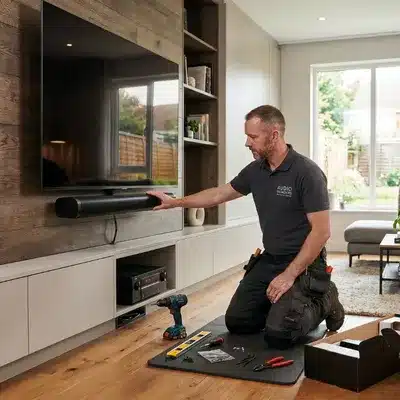
A professional home entertainment installation follows a clear process. Here is what to expect:
- Discovery Call: Review your goals, rooms, and how you use each space.
- Site Survey: Assess construction access, network coverage, and speaker placement.
- System Design: Define zones, equipment list, and control approach.
- Pre-Wire (New Builds): Pull cable and install backboxes before drywall closes.
- Retrofit Wiring: Fish cable through existing walls with minimal disruption.
- Trim-Out: Mount speakers, terminate wiring, and build the equipment rack.
- Configuration: Set up networking, apps, automation, and audio sources.
- Calibration: Tune levels, delays, room correction, and subwoofer integration.
- Client Handoff: Training, documentation, and support plan delivered.
Pre-wire (First Fix) and trim-out (Second Fix) stages are clearly defined in CEDIA’s technician training. One day is all it takes to complete a single-room conversion. Installing a wired multiroom system usually takes a few days. Timelines are weeks long since new builds are coordinated with drywall and framing.
Are you prepared to modernize your house? Waco and the surrounding Central Texas regions are served by Custom Integrators. With a one-year service warranty, we manage the entire sound system installation process for homes, from design to calibration. For a free quote, get in touch with us right now.
How much will it cost to install a home audio system in 2026?
For one or two rooms, entry-level installations usually cost between $1,500 and $7,500. Depending on zones, equipment, and network improvements, whole-home audio with numerous zones can cost anywhere from $7,500 to $25,000 or more.
What is included in a professional home entertainment installation?
A complete home entertainment installation includes designing the system, wiring it, mounting the equipment, setting it up, and calibrating it. It also includes training for clients and, with Custom Integrators, a one-year warranty on service.
Should I get wired or wireless audio for my whole house?
Most homes do best with a mix of both. Wired speaker runs look better and work more reliably, while network-connected zone amps let you stream more easily. No matter what, a strong Wi-Fi network is important.
What do I need for Dolby Atmos home theater services?
To use Dolby Atmos in your home theater, you need to put speakers above the screen, have an Atmos-capable receiver or processor, and calibrate the room correctly. A pro will also talk about how to treat the acoustics to get the most out of the format.
How long does a home sound system installation take?
A single-room retrofit can be completed in one day. A wired multi-room install typically takes several days. New construction prewire is done during framing, with trim-out and calibration happening after the home is finished.
Do I need a permit for home speaker installation?
Permits are frequently not needed for low-voltage audio work. Local codes can be relevant if your project includes substantial wall work or new electrical circuits. During the design stage, your installer should verify the specifications.
Since 2009, Custom Integrators has provided start-to-finish service and a one-year service warranty for the design and installation of home technology systems in Central Texas. This experience enables homeowners to purchase a sound system that is well-planned, neatly built, and calibrated to function well from the start.
Are you prepared to upgrade your home’s audio system with one that fits your lifestyle and space? Get expert installation supported by a staff that is familiar with Central Texas houses by scheduling your free estimate with Custom Integrators right now.