
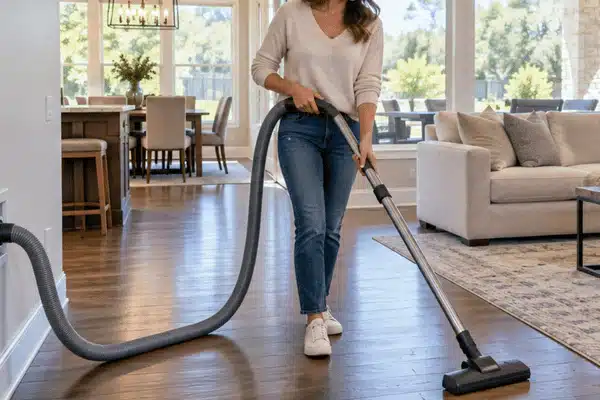
The cost of a central vacuum system isn’t the same for every house. Angi puts a typical 2026 installation at $1,094 to $2,194, with $1,583 as the national average. Its full range runs from about $240 for smaller homes to $3,000 for large or custom installations. Want a hose that disappears into the wall? That will usually cost more.
This guide covers what drives the price, how a system fits into a slab-built Central Texas home, the electrical and permit basics, and how a built-in system compares with a cordless stick vacuum.
Table of Contents
What Is the Central Vacuum System Cost in 2026?
Here’s what you can expect to pay for different central vacuum setups.
| Installation Type | Estimated Cost | Source |
| Standard professional installation | 1,094–2,194 | Angi, July 2026 |
| National average | $1,583 | Angi, July 2026 |
| Standard hose system | 1,200–2,800 | M.D. Manufacturing |
| Retractable Hide-A-Hose system | 2,400–3,900 | M.D. Manufacturing |
| Standard and retractable hybrid | 2,400–3,000 | M.D. Manufacturing |
Angi’s figures reflect national pricing. Hide-A-Hose MD, the brand formed after Hide-A-Hose acquired M.D. Manufacturing in 2025, provides sample costs for homes around 1,800 to 3,000 square feet and notes that independent local installers set the actual prices. For reference, the median single-family home completed in the U.S. in 2024 measured 2,146 square feet, according to the Census Bureau.
Neither source gives a confirmed Central Texas average. For a price that reflects your home, you’ll need a local estimate.
What Affects Central Vacuum Installation Costs?
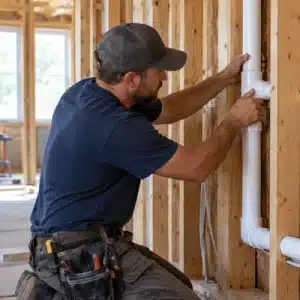
Two homes with the same square footage can have very different installation costs. Much depends on where the pipes need to go and how easy they are to reach.
Before giving you a price, an installer will want to know a few things:
- House size: A spread-out floor plan might need more wall inlets, even if the house isn’t especially large.
- Hose type: The kind that tucks into the wall costs more than a hose you coil up and store.
- Wall access: It’s easier to work in an open attic. Finished walls may mean extra cutting and patching.
- Power unit: A bigger motor or additional cleaning tools will add to the price.
- Accessories: A VacPan floor inlet runs about $250 to $500, based on M.D. Manufacturing’s estimates.
Electrical work may also need a permit. Waco requires permits for most new residential electrical work, though some minor jobs are exempt. Check local rules before starting.
How Does a Central Vacuum System Work?
Wondering how a central vacuum system works without dragging a machine around?
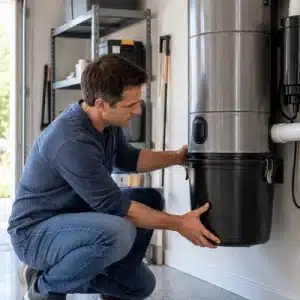
The motor and dirt canister sit away from your living space, often in the garage. Pipes hidden inside the walls connect the motor to the vacuum inlets throughout the house. Hide-A-Hose MD’s installation instructions call for 2-inch vacuum tubing, and the layout usually works like a trunk line that branches out to each inlet through the attic, walls, and other hidden spaces.
Here’s what happens when you clean:
- Plug your vacuum hose into a wall inlet.
- A low-voltage signal switches on the motor. A thin, low-voltage wire runs from each inlet back to the power unit alongside the pipe.
- Dirt travels through the pipes into the collection canister.
- Empty the canister or replace its bag when needed.
The motor runs on household electricity, often through a dedicated outlet. You only need to carry the hose and cleaning attachment from room to room. Hide-A-Hose MD says pipe length and the number of stories are not a problem for suction.
Can You Install a Central Vacuum in an Existing Home?
Yes, you can add a central vacuum to many existing houses. You don’t need to be building a new home to enjoy one. Hide-A-Hose MD says homes of any age can be retrofitted, and that one-story homes tend to be easier than homes with two or more stories.
Installers look for routes through attics, closets, crawl spaces, and other areas where pipes can stay hidden. Soffits, pantries, stud bays, and interior walls can also carry pipe and wire.
For example, a single-story Waco home with an open attic may be easier to work on. A two-story home with little wall access could need more planning and repairs. Angi notes that retrofitting usually costs more than installing during new construction, especially when walls are already finished.
Building a new house? That’s a good time to plan your central vacuum installation. Pipes can go in before drywall, alongside other planned home systems. Hide-A-Hose MD says the pipe and wiring are typically roughed in as the electrician is finishing, with temporary plaster guards protecting the pipe while drywall, mud, and paint go on. If you’re already planning low-voltage prewire for audio, networking, or smart home controls, the vacuum rough-in can be scheduled in the same window.
Can You Install a Central Vacuum in an Existing Home?
Yes! Both existing and newly built homes can have a central vacuum system.
Existing Homes
Retrofitting is possible. Pipes and wiring can be routed through attics, closets, crawl spaces, and hidden wall areas.
Installation Difficulty
Easier: Single-story homes with open attics.
More work: Multi-story homes or finished walls with limited access.
New Construction
Install before drywall. Pipes and wiring can be placed during construction.
Coordinate with low-voltage prewiring for other home systems.
Are Retractable Hoses Worth the Extra Cost?
If you’ve ever struggled to coil up a long vacuum hose, a retractable system may appeal to you.
Hide-A-Hose systems store the hose inside special pipes in the wall. You pull out the length you need, clean the room, then let the suction draw it back in. Available hose lengths include 30, 40, 50, and 60 feet. For most homes, Hide-A-Hose MD says two retractable inlets with a 50-foot hose can cover every area.
There is a trade-off. Hide-A-Hose MD notes that retractable inlets can’t run an electric carpet brush, and installation is more involved. Standard inlets can use an electric brush, so a hybrid setup, with retractable inlets in some areas and standard inlets in others, can make sense for homes with a lot of carpet.
Here’s a quick way to choose:
| What Matters Most | Best Option |
| Keeping costs down | Standard removable hose |
| Less hose storage | Retractable hose |
| Different needs on each floor | Hybrid setup |
| Sweeping up kitchen crumbs | VacPan floor inlet |
Retractable hoses are handy, but not every home needs them. A standard setup can do the job for less money.
Central Vacuum vs Dyson: Which Is Better?
The central vacuum vs Dyson comparison depends on how you normally clean.
For crumbs under the breakfast table, you might reach for a cordless Dyson. For floors across several rooms, a central vacuum gives you a different way to tackle the job.
| Feature | Central Vacuum | Dyson-Style Cordless Vacuum |
| Power | Household electricity | Rechargeable battery |
| Where dirt collects | Large canister outside living areas | Small bin on the vacuum |
| Motor noise | Motor usually runs away from the rooms | Motor runs beside you |
| Getting started | Pipes and wall inlets must be installed | No built-in installation |
| Handy for | Cleaning throughout the house | Crumbs and quick touch-ups |
You may find both useful: the cordless stick for small spills and the built-in vacuum when it’s time to clean the whole house.
Can a Central Vacuum Improve Indoor Air Quality?
It depends on how the vacuum handles dust and exhaust.
The U.S. Environmental Protection Agency says a true HEPA filter can theoretically remove at least 99.97% of airborne particles measuring 0.3 microns, and that larger and smaller particles are trapped with even higher efficiency. However, not all central vacuum systems use HEPA filters.
Exhaust matters too. Hide-A-Hose MD explains that cyclonic units can pass fine dust through the motor, so most cyclonic systems are vented outdoors. Some bag-filtered units clean the exhaust well enough that outdoor venting isn’t needed.
A 2004 study published in Indoor Air tested vacuum cleaning in 12 homes. Researchers found no significant difference in airborne dust or cat allergens between central and regular vacuums. Airborne dust rose considerably during vacuuming with both types, and the researchers concluded that allergen-avoidance advice for people with allergic asthma doesn’t necessarily need to include switching to a central vacuum.
A central vacuum isn’t a guaranteed solution for allergies. Ask about filtration and exhaust options if indoor air quality matters to you.
Is a Central Vacuum Worth It?
A central vacuum is worth considering if you have a large home or clean several rooms regularly. It’s also a practical option when building or remodeling, since the pipes can be planned early.
You may appreciate having the motor outside your living space, especially if vacuum noise bothers you.
On the other hand, a portable vacuum may be all you need in a smaller house. It costs less upfront and doesn’t require any changes to your walls.
What is the average central vacuum system cost?
Angi’s July 2026 figures put the average at $1,583 nationwide. Its reported range is $1,094 to $2,194. A quote can go up if piping is difficult to route or if you choose a retractable hose.
How many central vacuum inlets does a house need?
It depends on your floor plan and how far your hose can reach. Angi suggests three to four inlets for homes measuring 1,500 to 2,500 square feet. An installer can map out the best spots so you can reach each room.
How long does a central vacuum installation take?
Some professional installations can be finished in one day, according to M.D. Manufacturing. Older homes with limited access may take longer. Your installer can give you a better timeline after checking the property.
Can I replace an old central vacuum without changing the pipes?
Yes, you can often keep the pipes you already have. The important thing is whether they’re clear, undamaged, and suitable for the new power unit. Have the installer check the lines and fittings before spending money on replacement parts.
Do I need a permit for central vacuum installation in Central Texas?
There isn’t one permit rule for all of Central Texas. In Waco, most new residential electrical work requires a permit, though exceptions apply. Ask the city or county office that covers your address what approval your project needs.
How does a retractable central vacuum hose work?
The hose stays inside a specially designed pipe when you’re not using it. Pull out the length you need and start cleaning as usual. Once finished, the suction pulls the hose back into its storage pipe, so there’s nothing to coil or hang up.
If you’re thinking about adding a central vacuum, start with your floor plan and how you like to clean. Custom Integrators helps homeowners across Waco, Temple, Belton, Killeen, and nearby Central Texas communities choose and install the right setup. Explore our central vacuum installation services and request a free estimate to find out what your home needs.