
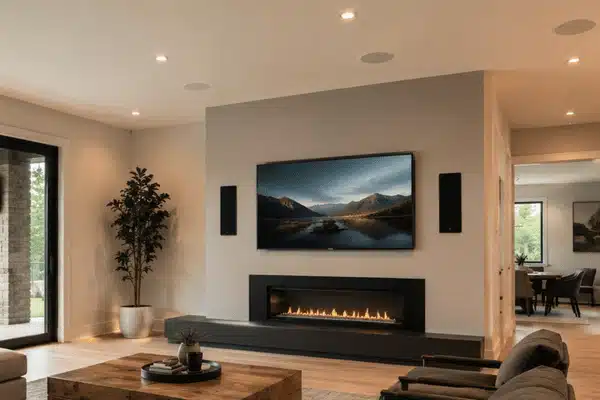
Getting home speaker installation right starts with one simple question: what does each room need? Ceiling speakers are great for music and Dolby Atmos height effects. Surround speakers create ear-level movie sound. Outdoor speakers need weather-rated parts, not indoor speakers moved outside.
Table of Contents
Home Speaker Installation by Room
A good speaker plan starts with the room, not the product.
Here is a simple guide:
| Room Type | Best Speaker Choice | Main Use |
| Kitchen | Ceiling speakers | Background music |
| Living room | Ceiling or wall speakers | TV, music, and daily use |
| Theater room | Ear-level surround speakers plus height speakers | Movies and games |
| Patio | Weather-rated outdoor speakers | Music outside |
| Whole home | Zoned audio system | Room-by-room control |
Best results come from matching the speaker to the space. This helps avoid weak sound, harsh sound, or poor coverage.
What Ceiling Speakers Are Best For
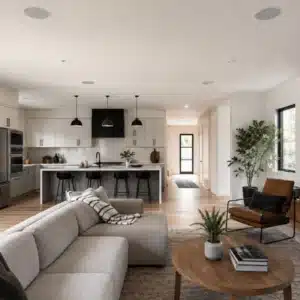
Ceiling speakers work well when you want sound without visible speakers.
They are a strong fit for:
- Kitchens
- Hallways
- Bedrooms
- Open living areas
- Dolby Atmos height channels
- Whole home audio zones
Dolby explains that a 7.1.4 setup uses a 7.1 surround layer with four overhead speakers. Those overhead speakers add height effects, such as rain, aircraft, or sound that moves above the listener.
Ceiling speakers should not replace the main surround layer in a serious theater. Dolby’s layout advice keeps the main speakers near seated ear height. That is why front, side, and rear speakers still matter.
For movie rooms, use ear-level speakers first. Then add ceiling speakers for height.
How to Choose 6-Inch vs. 8-Inch Ceiling Speakers
Many homeowners ask how to choose between 6-inch and 8-inch ceiling speakers.
Here is the simple answer:
| Room Type | Recommended Size |
| Small bedroom or office | 6-inch or 6.5-inch |
| Medium living room | 6-inch or 6.5-inch |
| Large open room | 8-inch |
| Room needing fuller bass | 8-inch |
A 6-inch or 6.5-inch speaker is a safe choice for most homes. It gives clean sound and fits many rooms.
An 8-inch speaker can give fuller low-end sound. It is useful in large rooms or open spaces. It can also help when you want stronger bass without adding many visible speakers.
For home theater height channels, 6-inch or 6.5-inch models usually work well. Choose aimable or angled models when the seating area is not right under the speaker.
Are Angled Ceiling Speakers Worth It?
Yes, angled ceiling speakers can help in the right room.
Standard ceiling speakers fire straight down. This can create a “shower effect,” where the sound feels like it is falling from above instead of moving toward the seating area.
Angled models point sound toward the listener. Focal describes tilted ceiling speaker designs as a way to reduce this effect. JBL also offers angled baffle designs that aim sound toward the listening area.
Are Angled Ceiling Speakers Worth It?
Yes, especially when sound needs to aim toward the listener instead of firing straight down.
Home Theaters
Creates more natural height effects for movies, games, and Dolby Atmos setups.
Media Rooms
Helps direct sound toward the seating area for clearer, more focused audio.
Off-Center Seating
Improves coverage when listeners are not directly below the ceiling speaker.
Hard-to-Place Spots
Makes installation easier when ceiling locations are limited by layout or wiring.
Angled ceiling speakers are useful in:
- Home theaters
- Media rooms
- Rooms with off-center seating
- Rooms where ceiling spots are hard to place
Use angled speakers when aim matters. They can make height effects feel more natural.
Outdoor Speaker Installation Services
Outdoor speaker installation needs the right equipment. Indoor speakers should not be used outside.
Outdoor speakers must be built for weather, heat, moisture, and dust. Polk’s Atrium line is made for outdoor use and tested for weather exposure. Many outdoor speaker lines are also made for patios, decks, pool areas, and covered porches.
Surface-mount speakers are only for outdoor use if they are rated for outdoor use. A typical indoor surface-mount speaker could fail when subjected to moisture or temperature changes.
Items to be installed on plan :
- Speaker Wire Routing
- Where to locate the amplifier
- Outdoor Sound Zones
- Speaker size and coverage area
- Exposure to weather
- Height and angle of mounting
Home speaker installation services can assist in placing speakers before the wiring begins. This is because the sound in the outdoor environment behaves differently from the sound in the indoor.
A small porch may need compact speakers. A large patio may need more output or more speaker points.
Wired vs. Wireless Surround Sound
Both wired and wireless surround systems can work well. The right choice depends on your room, budget, and gear.
| Feature | Wired 7.1 | Wireless Surround |
| Speaker choice | Wide range | Brand or system-based |
| AVR support | Broad | More limited |
| Cable runs | Required | Reduced |
| Power needs | From an amp or outlet | Still needs power |
| Retrofit work | More work | Easier in many rooms |
| Long-term flexibility | Strong | Depends on ecosystem |
Wired 7.1 gives more speaker choice and better upgrade options. It is a strong choice for dedicated theaters.
Wireless surround can reduce long speaker-wire runs. Sonos says its surround speakers connect wirelessly to the main home theater product, but they still need a correct setup and power. WiSA also supports low-latency wireless multi-channel audio for some systems.
“Wireless” does not mean no work. It means fewer signal wires.
If you want clean results, surround sound installation services can help with wiring, placement, and setup.
Whole Home Audio and Smart-Home Control

In 2026, speaker systems are not just about sound. They are also about control.
Whole home audio lets you play music in one room, several rooms, or the full home. Systems like Control4 can connect speakers with lighting, scenes, outdoor zones, and voice control.
New smart-home devices are also changing the way people listen to audio. Google announced a new Home Speaker with Gemini for more natural voice control. Matter 1.6 also emphasizes simplified setup and better device connections across smart-home systems.
It means audio can fit into the daily routine.
For example:
- In the kitchen, music can play in the morning.
- Turn on the patio speakers for al fresco dining.
- Movie mode can dim the lights and turn on the surround sound.
- Bedroom audio may be independent of the living room.
Good speaker installers plan the speakers, wiring, controls, and zones together. This makes the system feel simple after installation.
How do height and ceiling speakers enhance the surround sound experience?
Height and ceiling speakers add sound from above. In Dolby Atmos layouts, they help place effects over the listener. This makes the movie sound feel more three-dimensional.
How do I choose the best 6-inch ceiling speakers for my home theater?
Choose 6-inch or 6.5-inch ceiling speakers with aimable or angled drivers. They should point the sound toward the seats. Also, make sure they match your receiver and main speaker system.
How do I choose between 6-inch and 8-inch ceiling speakers?
Use 6-inch or 6.5-inch speakers for most rooms. Choose 8-inch speakers for large rooms or stronger low-end sound. Room size and speaker placement matter more than size alone.
Can angled ceiling speakers improve sound quality in a home theater?
Yes. Angled ceiling speakers can aim sound toward the seating area. This helps reduce straight-down sound and makes height effects feel more natural.
Can surface-mount speakers be used outdoors and are they weatherproof?
Yes, but only if they are rated for outdoor use. Indoor surface-mount speakers are not made for moisture, heat, or cold. Use weather-rated outdoor models for patios, decks, and exposed areas.
What are the main differences between wireless 7.1 surround sound systems and wired ones?
Wired 7.1 systems offer more speaker choice and stronger upgrade options. Wireless systems reduce long speaker-wire runs but still need power. Wireless systems may also lock you into one brand or platform.
A smart home speaker installation starts with room needs, speaker placement, and wiring plans. Ceiling, surround, and outdoor speakers each have a different job. When they are planned together, the result is cleaner sound and easier daily use.
Ready to plan your home audio system? Get a free quote from My Custom Integrators to learn how professional speaker installers can help with ceiling speakers, surround sound, outdoor audio, and whole home audio control.