
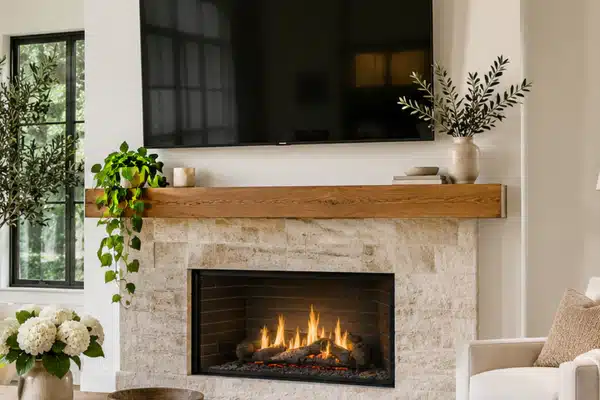
A TV above fireplace setup can make a living room look neat and save valuable wall space. But before you start drilling, there’s more to think about than where the screen will look best. Heat, wall strength, and viewing height all matter. Some fireplaces work well with a TV above them, while others simply aren’t suited for it.
Before mounting anything, find out how hot the wall gets when the fireplace is running. Samsung and LG both list 104°F (40°C) as the upper limit of their TVs’ operating range. Samsung even suggests lighting a fire and checking the temperature first. You’ll also want to think about where you’ll sit. CE Pro, a trade publication for the custom integration industry, recommends keeping the vertical viewing angle within 15 degrees. A tall mantel can make that tricky. Then there’s the wiring. Since September 1, 2026, non-exempt electrical work in Texas must follow the 2026 National Electrical Code. That means you can’t simply tuck a regular TV power cord inside the wall.
None of this means you have to give up on the idea. Some fireplaces have built-in heat-management features that let you mount a TV just 12 inches above the opening. A pull-down mount can also make a high screen easier to watch. And if you want the wiring out of sight, there are listed in-wall power kits designed for that purpose. The key is knowing what your particular setup allows before you start drilling.
Table of Contents
Is a TV Above Fireplace Setup Safe?
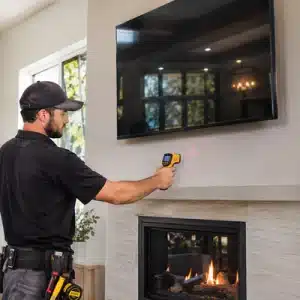
Can you mount a TV above a fireplace? Yes, but it depends on the fireplace and the space above it.
Before going ahead, there are a few things worth checking:
- Fireplace instructions: Some models allow TVs above them, while others have strict limits.
- Heat levels: The area around the TV must stay within its rated temperature range.
- Wall strength: The wall needs to hold the TV and mount without putting too much stress on it.
- Electrical setup: Power outlets and cables must be installed safely.
Samsung advises against placing its TVs above fireplaces. The company also warns that its TVs should never exceed 104°F (40°C).
Other brands may have different limits, so check your TV’s manual first.
How Does Fireplace Heat Affect Your TV?
Your TV may look fine above the mantel, but that doesn’t mean it’s safe from heat. Warm air rises, and the space above a fireplace can get surprisingly hot.
Over time, excess heat may harm the screen or other parts inside the TV. Heat speeds up wear on electronic components. Capacitor makers such as Panasonic and KEMET note that the expected life of an aluminum electrolytic capacitor, a common part in electronic power supplies, roughly doubles for every 10°C (18°F) drop in operating temperature. The same rule works in reverse: the hotter these parts run, the shorter their expected life.
The type of fireplace also makes a difference.
| Fireplace Type | What You Need to Know |
| Wood-burning | Heat can change quickly, and soot may collect around TV vents. |
| Traditional gas | Safe placement depends on the model, mantel, and ventilation. |
| Direct-vent gas | Some models have systems that keep excess heat away from the wall. |
| Electric | Many send warm air forward, but heater vents still need enough clearance. |
Some newer fireplaces are designed with TV placement in mind.
For instance, certain Heat & Glo models allow TVs just 12 inches above the opening. This only applies when the approved heat-management setup is used.
A mantel may help direct warm air away from your screen, too. Still, its size and position determine how much protection it provides.
How High Should You Mount Your TV?
Ever watched a movie from the front row of a cinema? Looking up at a screen for too long can leave your neck feeling sore.
The same thing can happen when your TV sits too high above the fireplace.
For comfortable viewing, aim to keep the middle of the screen close to seated eye level.
CE Pro, a trade publication for the custom integration industry, advises keeping the vertical viewing angle to no more than 15 degrees. Anything steeper has viewers craning their necks. The publication also notes that a fireplace mantel usually pushes a TV well above the general height recommendation.
Before settling on a mounting height, try checking the view from your usual seat:
- Sit on your sofa where you normally watch TV.
- Measure how high your eyes are from the floor while seated.
- Mark that height on the wall so you have a reference point.
- Check how much space the fireplace manufacturer requires above the opening.
- Compare the two measurements. If the TV has to sit much higher, think about whether you’ll be comfortable watching it.
Sometimes, the fireplace forces you to place the screen higher than you’d like.
A tilting mount can help improve the angle. If the height still feels awkward, a pull-down mount may be worth considering.
Sit in your usual TV viewing spot.
Measure from the floor to your seated eye level.
Use your eye-level measurement as a reference.
Follow the fireplace manufacturer’s clearance rules.
Compare both measurements for comfortable viewing.
Which TV Mount Should You Choose?
Not every wall mount works the same way. The right choice depends on how high the screen sits and where people usually watch from.
| Mount Type | When It Makes Sense |
| Fixed | Your TV is already at a comfortable height. |
| Tilting | The screen sits a little higher than your eyes. |
| Full-motion | You want to turn the TV toward different seats. |
| Pull-down | The TV needs to move lower when you’re watching. |
A pull-down TV mount is useful when the fireplace puts your screen well above eye level.
You can bring the screen down for movie nights, then move it back up afterward.
Just remember that lowering the TV may bring it closer to the heat. Both positions must meet the required safety limits. Some pull-down mounts have heat-sensing handles that turn red when the temperature above the fireplace goes past 110°F (43°C). Even so, MantelMount, which makes these mounts, says it does not encourage keeping the TV lowered while the fireplace is on. Because 110°F is higher than the 104°F limit Samsung and LG list, treat the color change as a warning sign, not proof that the temperature is safe.
Before buying any mount, check its weight rating, VESA hole pattern, and wall requirements. Make sure there’s also enough room for the TV to move without hitting the mantel.
What About Mounting a TV Above a Brick Fireplace?
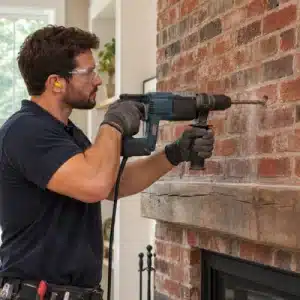
Brick may look sturdy, but you shouldn’t assume every brick wall can hold a large television.
Mounting a TV above a brick fireplace takes the right tools and a good look at the wall.
A few things matter here:
- Take a close look at the bricks. Are any loose, cracked, or starting to crumble? If so, the wall may not be a reliable place to attach a heavy TV.
- Get anchors made for the job. Regular wall fixings won’t do. You’ll need hardware suited to the masonry and rated for the combined weight of the TV and mount.
- Find out whether it’s solid brick or just a facing. Decorative brick or stone veneer may look substantial, but it isn’t necessarily strong enough to support a wall mount on its own.
- Know what’s behind the drilling area. You don’t want to discover a flue, vent, or other fireplace component after you’ve already made a hole.
Ordinary drywall anchors aren’t made for brick. On solid brick, both MantelMount and brick manufacturer Pine Hall Brick advise drilling into the brick itself, not the mortar joints, because mortar is softer and won’t hold as well. The job also calls for a hammer drill and a masonry bit.
If you’re unsure what’s behind the surface, have an installer inspect it before making holes.
How Can You Check Heat and Wiring Safety?
Before mounting anything, run your fireplace under normal high-heat conditions until temperatures settle.
Check the heat around the spot where the TV will sit. The TV must remain within its rated operating range during use. Samsung gives the same advice: light a fire and check the temperature before mounting a TV above a fireplace. Then compare your reading with the operating range in your TV’s manual.
You may also be considering a heat shield for TV above fireplace installations.
A suitable shield can help move heat away from the screen. However, it won’t make every fireplace safe for TV mounting.
Follow the fireplace maker’s instructions rather than relying on a shield alone.
If you’d rather not see cables hanging below the screen, have a qualified electrician put an outlet behind the TV. A listed in-wall power system may be another option, provided it’s installed according to code.
Is it safe to mount a TV above a fireplace?
It can be safe when both the fireplace and TV manufacturers allow it. You’ll also need a strong mounting surface and safe electrical connections. If the space gets too hot, choose another wall instead.
Can you mount a TV above a wood-burning fireplace?
You can, but you need to be careful about the heat. Wood fires don’t always burn at the same temperature, and smoke or soot can get into your TV’s vents. If the area above the fireplace gets too hot, it’s best to find another spot for your TV.
How high should a TV be above a fireplace?
The best height depends on your fireplace and where you sit to watch TV. Ideally, you should be able to watch without tilting your head back too much. If the fireplace forces you to mount the screen higher, a pull-down mount can help bring it closer to eye level while you’re watching, as long as it stays clear of the heat.
Is a pull-down TV mount worth buying?
It can make a real difference when your screen sits high above the mantel. Instead of looking up the whole time, you can lower the TV while watching. Just make sure the lowered position is safe when the fireplace is in use.
Does a heat shield for TV above fireplace installations really help?
Yes, a properly designed shield can redirect some of the heat. How well it works depends on the fireplace, shield design, and placement. It cannot replace the clearances set by the fireplace manufacturer.
Is mounting a TV above a brick fireplace safe?
Yes, provided the brick and mounting hardware can safely hold the weight. Decorative brick or stone may need extra structural support. Have the wall checked before drilling, especially if you’re unsure what’s behind it.
Can I hide my TV power cord inside the wall?
A standard TV power cord should never be run through a wall cavity. It isn’t designed to serve as permanent in-wall wiring. Use a code-compliant outlet or a listed in-wall power system installed the right way.
Is an electric fireplace better for mounting a TV above it?
Some electric fireplaces direct warm air into the room instead of toward the wall above. This may make TV placement easier compared with certain wood-burning or gas units. You still need to check the heater’s clearances and your TV’s temperature limits.
Putting a TV above your fireplace can work well, but getting the setup right matters more than how it looks. From checking the wall to choosing a mount and planning the cables, each detail deserves attention. Custom Integrators provides professional TV mounting services across Waco, Temple, Belton, Hillsboro, Salado, Harker Heights, and Killeen. If you’re planning an installation, there’s no need to guess what will work. Contact Custom Integrators today to request a TV mounting estimate.